What Is Magnetic Drive? How Does It Work?
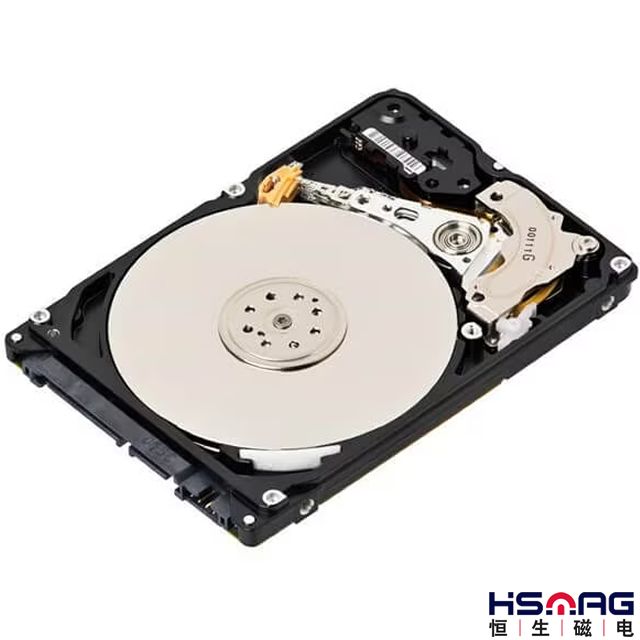
What Is Magnetic Drive? How Does It Work? Quick Answer: What is a Magnetic Drive & How Does It Work? The Definition: A magnetic drive (such as a Hard Disk Drive or HDD) is a non-volatile, secondary storage device that uses spinning flat circular platters coated with a magnetic material to store digital data permanently. How it Works: Data is written binary style as millions of ones and zeros (1s and 0s) onto microscopic tracks. An automated actuator arm positions a read/write head fractions of a millimeter above the spinning platter, altering the magnetic polarity (North vs. South poles) of individual sectors to encode files. Main Advantage: Magnetic drives remain the most cost-effective solution for high-capacity local data storage, providing significantly more gigabytes per dollar than high-speed RAM or Solid-State Storage (SSDs). Core Weakness: Because [...]
2026 Magnet Report: Rare Earths & Supply Chain Truths
2026 Magnet Report: Rare Earths & Supply Chain Truths In 2026, the global magnet industry stands at a critical crossroads defined by resource constraints, technological bifurcation, and geopolitical restructuring. Demand from humanoid robots and high-performance electric drives is rapidly reshaping the global supply chain. We are entering a hybrid era: rare earth magnets continue to anchor high-end applications, while rare-earth-free technologies are emerging as a vital shield for supply chain security. For industry buyers, understanding this dual-track trend is essential for making smarter sourcing and investment decisions. Key Takeaways 2026 global magnet industry runs on light rare earth & REE-free dual-track layout. NdPr deficit expands; heavy rare earth prices keep surging. REE-free tech is supplementary, not a full replacement for high-end scenarios. GBD technology dominates high-performance magnet cost & performance optimization. China’s rare earth supply [...]
Why do Permanent Magnet Motors Demagnetize?
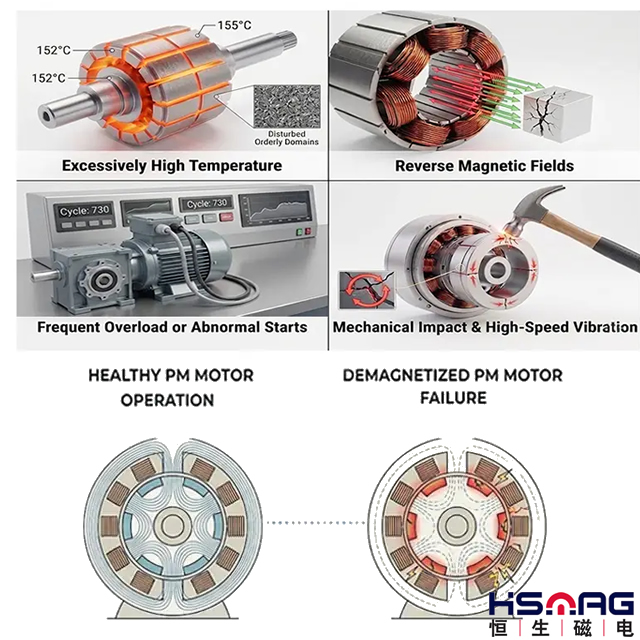
Why do Permanent Magnet Motors Demagnetize? A permanent magnet VSD (Variable Speed Drive) air compressor runs for less than two years. Then, it suddenly has unexplained high current and frequent inverter overload alarms. When checked, the magnets’ magnetic flux density has dropped by nearly 30%. This problem is common. Demagnetization is the most hidden failure mode for PM motors. Unlike a burnt coil that stops the machine right away, demagnetization lets the equipment keep running in a “sub-healthy” state. By the time problems become obvious, the damage is often irreversible. Knowing why demagnetization happens helps you fix issues and prevent risks during design and selection. Key Takeaways Focus on preventing irreversible demagnetization of permanent magnet motors; conduct back EMF sampling quarterly. Five core causes of demagnetization: high temperature, reverse magnetic field, overload/start-stop, mechanical impact, design [...]
Arc Magnet vs Block Magnet: Key Differences in Motor Applications
Arc Magnet vs Block Magnet: Key Differences in Motor Applications In permanent magnet motor design, magnet shape directly affects motor efficiency, torque performance and manufacturing cost. Arc magnets and block magnets are the two most widely used magnet types for motors. They can be manufactured from identical magnetic materials. However, differences in air gap, magnetic field distribution and structural compatibility will lead to obvious distinctions in actual operating performance. Understanding their differences is essential for proper magnet selection. This article illustrates their core features and helps you make accurate choices according to your practical working conditions. Key Takeaways Core difference between arc magnets and block magnets is geometry, which determines their magnetic field traits and motor compatibility. Arc magnets have a smooth magnetic field, ideal for high-performance rotating motors (SPM motors, servo motors) to boost [...]
How Segmented Magnets Reduce Eddy Current Loss
How Segmented Magnets Reduce Eddy Current Loss Magnet segmentation is one of the most effective solutions to suppress eddy current loss in high-speed permanent magnet motors. As modern motors continue trending toward higher rotating speeds and higher operating frequencies, eddy current loss has become a critical bottleneck restricting motor efficiency, thermal stability, and service life. Conventional integral magnets feature a simple structure but suffer from severe internal circulating currents under high-frequency alternating magnetic fields. These closed-loop eddy currents generate excessive heat, cause irreversible demagnetization, and reduce overall motor performance. For high-performance motor applications, segmented magnet design has become a standard and necessary optimization strategy. Key Takeaways Segmented magnets reduce eddy current loss by breaking conductive current loops. Smaller segment size significantly lowers heat generation and demagnetization risk. High-speed motors benefit most because eddy loss rises [...]
What is Passivation for NdFeB Magnets?
What is Passivation for NdFeB Magnets? NdFeB magnets have become the most widely used rare earth permanent magnets in modern industry due to their exceptional magnetic performance. However, because of the inherent characteristics of the material itself, NdFeB magnets are highly susceptible to oxidation and corrosion when exposed to humid environments, oxygen, acids, or alkalis. To solve this corrosion issue, surface treatment technologies have become a critical part of magnet manufacturing. Among all protective solutions, Ni-Cu-Ni electroplating and epoxy coatings remain the most common surface systems. However, in specific applications, passivation has emerged as an important surface treatment method because of its unique advantages. This article explains the working principles of NdFeB magnet passivation, major process classifications, complete processing procedures, differences between passivation and traditional electroplating, and the basis for selecting suitable surface treatments for [...]
NEODYMIUM POT MAGNETS
NEODYMIUM POT MAGNETS High Performance Pot Magnets Pot magnets are mighty magnets enclosed in a metal housing. They are commonly used to increase the magnet’s holding power and prevent it from being damaged. Being housed, the magnet can bear more pulling forces. Pot magnets can be used where adequate adhesion is needed. They are also known to be in great demand industrially in offices, homes, and DIY projects. They serve multiple purposes: securing, mounting, and attracting. Pot Magnets Designed for Fixing, Mounting & Positioning Pot magnets are a generic word for a variety of products. Pot magnets are built in a variety of shapes based on unique use cases and functional needs, with each being optimised for a specific application to give customers with more versatile and efficient solutions. Countersunk magnets Countersunk magnets Counterbore magnets [...]
NEODYMIUM SPHERE MAGNETS
NEODYMIUM SPHERE MAGNETS High Performance Ball Magnets The sphere magnets are powerful spherical magnets designed to ensure the even distribution of magnetic force. Hence, they can easily attach and hold several objects. They are more appropriately used for creative models, keeping documents, and constructing amusing stress-relief toys. However, they cannot be used for children’s toys. Please use it with caution to avoid the risk of swallowing. Sphere magnets Ball Magnets in Standard Sizes & Custom Options HSMAG offers a wide range of ball magnets in various sizes, from tiny to large specifications, ensuring you can select the right size for different application scenarios. Choosing the appropriate magnet size provides firm support, helping to bring your designs and ideas to life. Size is critical to ensuring the correct installation of the ball magnet in the project, [...]
NEODYMIUM COUNTERSUNK MAGNETS
NEODYMIUM COUNTERSUNK MAGNETS High Performance Countersunk Magnets Neodymium countersunk magnets are high-performance magnets uniquely shaped to allow secure mounting by screws or bolts. The unique countersink hole design allows the magnet to be fitted flush without protruding from the surface. Besides the standard round form, they come in square, single-hole, or double-hole, thus finding a wide application in kitchen renovations, exhibition arrangements, store displays, and furniture making. Countersunk magnets Countersunk Magnets in Standard Sizes & Custom Options The size of the neodymium countersunk magnets is directly related to their functionality. Larger magnets have a stronger magnetic pull and can carry higher loads; they are used where high stability and fixation for an extended period are required. On the other hand, smaller magnets allow for easier installation and more flexibility in space-restricted areas. Sizing is critical [...]
NEODYMIUM ARC MAGNETS
NEODYMIUM ARC MAGNETS High Performance Segment Magnets Neodymium arc magnets have an irreplaceable advantage in motor applications because of their unique, curved shape. They provide a strong and stable magnetic field in the rotation system, and such special size and shape make them indispensable in applications that require high precision. Neodymium arc magnets Arc Magnets in Standard Sizes & Custom Options The size of neodymium arc magnets defines the fields and devices they can serve. The big ones are used in motors and wind turbines, while the smaller ones are used in robotics, precision instruments, and sensors. The curvature and size of these magnets define the precise distribution of the magnetic field in rotating systems, ensuring optimal interaction between the magnetic field and the operational components. Sizing is critical to ensuring the magnet fits correctly [...]
NEODYMIUM BLOCK MAGNETS
NEODYMIUM BLOCK MAGNETS High Performance Bar Magnets Neodymium block magnets are compact rectangular magnets that provide a stable and robust magnetic field. Their geometry is particularly well-suited for applications requiring precise magnetic interaction in small motors, magnetic assemblies, and sensors. The design facilitates their integration into various systems, ensuring consistent and efficient performance in multiple industries. Neodymium block magnets Block Magnets in Standard Sizes & Custom Options The dimensions of block magnets directly affect their magnetic strength and the efficacy of their applications. An increased size would enhance the magnetic field strength, making it appropriate for heavy-duty industrial applications. However, it may provide challenges regarding spatial constraints and system design. The converse would be a dimension that would be optimal for specific space-restricted devices but might provide inadequate magnetic force for a designated function. Sizing [...]
NEODYMIUM ROD MAGNETS
NEODYMIUM ROD MAGNETS High Performance Rod Magnets Rod magnets are cylindrical magnets that generate powerful, focused magnetic fields along their length. It is ideal for applications that need accurate magnetic positioning or alignment. Their design makes them simple to incorporate into diverse systems, ensuring dependable industrial and commercial application performance. NEODYMIUM ROD MAGNETS Rod Magnets in Standard Sizes & Custom Options For specific applications, the rod magnet’s size directly impacts its magnetic performance. A giant rod magnet produces an extraordinarily intense magnetic force, making integration with other components complex and even causing misalignment issues. In contrast, a rod magnet that is too tiny may be unable to create enough magnetic strength to meet the requirements of any application. Sizing is critical to ensuring the magnet fits correctly in the system, resulting in maximum magnetic field [...]