
Magnetic Had Disk Drive
Computers have a (secondary) storage device called a disk drive, It is where all your apps are stored. There are currently two types of storage device, the magnetic hard disk drive and the solid state disk drive.
A computer (unopened)
A computer (opened) – Magnetic hard disk shown
A working magnetic hard disk drive
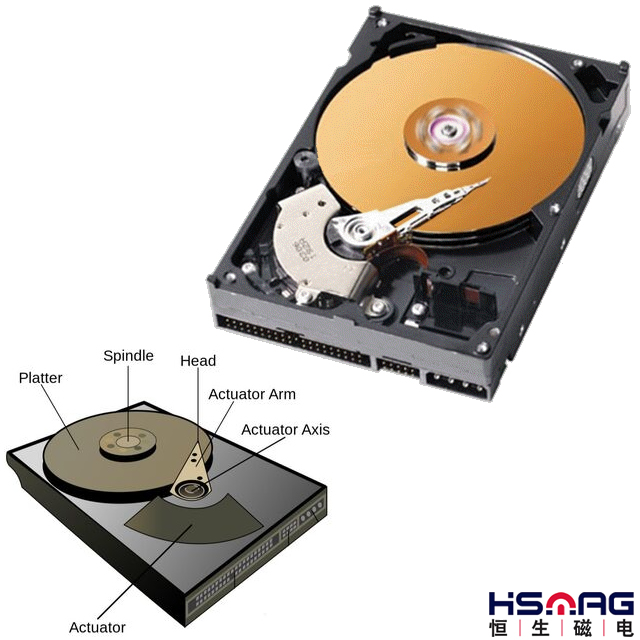
Magnetic had disk drive labelled
Magnetic Had Disk Drive
How does it work when I click save?
The spindle spins the platter.
The actuator arm moves across the platter.
Your saved information moves down the actuator arm to the read/write head.
The head changes the polarity in a particular sector (an area on the platter – see below) on the platter to either a number of north poles or south poles.
Having e.g. North pole, South pole, North, North, South etc is much like ones and zeros of binary (as per diagram on left).
Computer hard drive magnets are indispensable components within modern computing technology.
There was once a concern that magnets have the potential to erase data from our hard drives, cause disruptions in computer monitors, or interfere with the electron flow within cables. But these powerful magnets are integral to the functioning of hard drives responsible for reading, writing, and storing digital data on magnetic disks.
These magnets, typically composed of neodymium, balance size, strength, and precision to ensure efficient data processing and storage. Find out more below.
How magnets are used for computer hard drives
Magnets play a critical role in the functionality of computer hard drives, which are at the heart of data storage in modern computing.
Data storage relies on magnetism, as the hard disk’s surface is coated with a magnetic material containing countless tiny magnets. These magnets represent binary data, with their north and south poles denoting 0s and 1s.
To write and retrieve data, an electromagnetic head is essential. Electromagnets within this head can reverse their polarity by altering the direction of current flow. This allows them to reposition the magnetic orientation of the tiny magnets on the hard disk’s surface, enabling data to be written or read.
The precision and speed at which these magnetic interactions occur are vital for seamless data storage and retrieval in the digital age.
Our computer hard drive magnets
Due to their exceptional magnetic properties, neodymium magnets are preferred for computer hard drives. Neodymium magnets, often rare-earth magnets, are highly desirable for their strength, compact size and durability.
These magnets provide the magnetic fields for reading and writing data on the hard disk’s surface with precision and efficiency.
The magnets used in hard drives are typically small and cylindrical, allowing for precise control and alignment within the drive. They must also boast strong magnetic properties to represent binary data as 0s and 1s on the disk’s surface.
Our neodymium magnets retain their magnetic strength and remain stable under varying temperatures, ensuring data integrity and long-term reliability. We put data accuracy and storage efficiency first.
Black Epoxy Plated Arc N50 Magnets
Neo Segment Countersink Magnets
Customized Segment Magnet with Countersunk Hole
Rare Earth Segment Countersunk Magnet
Segment NdFeB Countersink Hole Magnet
N52 NdFeB Magnet Block 37X37X15mm