
Grade N55 Neodymium Magnets
Higher strength – 5–6% stronger performance than N52 magnets.
Precision use – Ideal for magnetic sensors and magnetic switches.
Miniature fit – Best choice for tiny magnets and small robots.
Durable design – Resistant to demagnetization, heat; coating protection required.
We are proud to offer N55 Super Magnets to our customers. This is not because all magnet factories can produce. Rather, it is smaller in size and stronger in magnetic force than N52.
Its performance is 5%-6% higher than that of N52 magnet. For precision applications such as magnetic sensors, magnetic switches, etc., N55 is the best choice.
Due to its strong magnetic field, the N55 is ideal for making tiny magnets and tiny robots.
Like other N-series neodymium magnets, N55 magnets are resistant to demagnetization and heat. And coating is also necessary for N55 to protect.
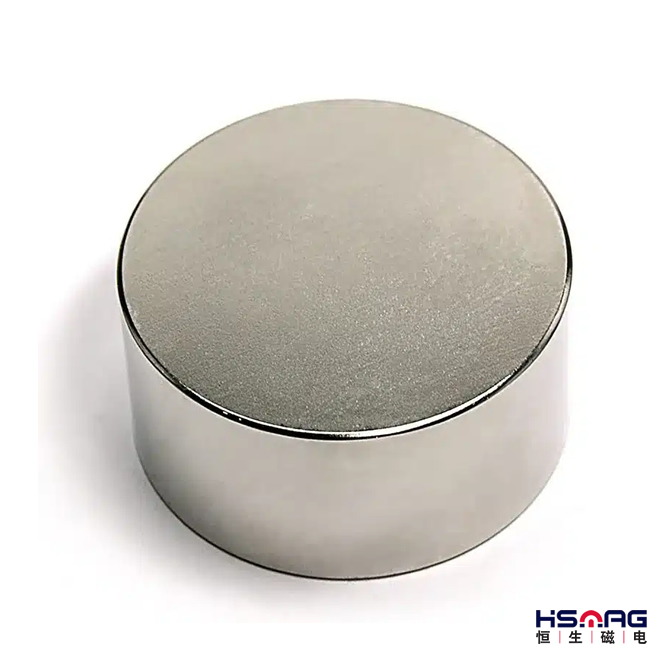
N55 neodymium magnets represent the current pinnacle of commercially available energy products within the “N” series of sintered neodymium-iron-boron (NdFeB) permanent magnets. These materials are classified by their maximum energy product (BH)max, which is measured in Mega-Gauss-Oersteds (MGOe). While the industry standard for high-performance applications has long been the N52 grade, the N55 grade offers a marginal but significant increase in magnetic flux density, typically providing a 2–3% improvement in performance over its predecessor.
The technical composition of N55 magnets is a marvel of modern metallurgical engineering. In standard NdFeB production, manufacturers often utilize praseodymium-neodymium (PrNd) alloys to balance magnetic properties. However, to achieve the specific remanence (Br) required for the N55 grade—which ranges from approximately 14.6 kGs to 15.2 kGs—manufacturers must employ high-purity neodymium (Nd) metal. This adjustment is necessary because there is an inherent physical trade-off between remanence (Br) and intrinsic coercivity (Hcj). As the remanence is pushed to its theoretical limit in the N55 grade, the material becomes more susceptible to demagnetization compared to lower grades, necessitating careful thermal management in the end-use application.
Physical Properties and Magnetic Characteristics
The magnetic strength of a permanent magnet is defined by the hysteresis loop, specifically the second quadrant where the magnet operates. The energy product,
(BH)max, is the product of the flux density B and the magnetic field strength H. For N55 magnets, this value reaches approximately 55 MGOe. In practical engineering, this allows for the miniaturization of devices. Because N55 magnets provide higher surface gauss than N52 magnets of the same geometry, they are highly prized in micro-magnetic engineering, high-precision sensors, and advanced magnetic separation equipment where space constraints are severe but high field gradients are mandatory.
From a structural standpoint, these magnets are produced through powder metallurgy. The process involves melting the raw materials, jet milling the alloy into a fine powder, aligning the particles in a magnetic field, and sintering them at high temperatures under vacuum or inert gas.[6] The resulting material is extremely hard and brittle, often requiring protective coatings such as nickel-copper-nickel (Ni-Cu-Ni) to prevent oxidation, as neodymium is highly reactive to atmospheric moisture.
Engineering Considerations and Limitations
When selecting N55 for an application, engineers must account for the temperature coefficient of the magnet. Neodymium magnets generally lose magnetic strength as temperature increases. Because N55 is optimized for maximum remanence, its coercivity is lower than that of high-temperature grades (such as the SH, UH, or EH series). If an N55 magnet is exposed to temperatures exceeding its threshold, it may suffer irreversible demagnetization. Consequently, N55 is typically reserved for room-temperature applications where the absolute maximum magnetic flux is the primary design requirement.
The mathematical relationship governing the magnetic energy density is expressed as:W=12μ0B2
where W is the energy density and μ0 is the permeability of free space. Given the higher Br of N55, the energy density is inherently higher, allowing for smaller motor volumes or more compact actuator designs in consumer electronics and medical devices.
Would you be interested in learning more about the specific temperature-dependent demagnetization curves of N55 magnets compared to high-coercivity grades like N52SH?
N52 Rectangular Magnet 20mmx10mmx3mm
Zinc Plated N50 Sintered Segment Magnet
N52 NdFeB Magnet Block 37X37X15mm
90 °Countersunk NdFeB Disc Magnet
Countersunk Disc Magnet Max.120 °C N35H
High Grade Disc Round Countersunk Magnet
Strong Neodymium Countersink Magnet Disc Shaped
Neodymium Magnet with 90 °Countersunk