
Rare Earth NdFeB Neodymium Disc Magnets
HSMAG supplies neodymium disc magnets for engineers, buyers, and builders who need dependable holding force in a compact round form.
Choose from N35–N56 grades, multiple coatings, and axial or diametric magnetization—with sampling support before volume.
High-grade capability (up to N56) — solve high-force requirements when space is tight.
Coating options in-house coordination — match corrosion/wear needs without supplier hopping.
Tolerance control + repeatable batches — consistent fit across reorders and production runs.
Samples first, then scale — validate performance quickly before committing to volume.
Neodymium Disc Magnets Sizes (D×T), Grades, Coating
Use the table to shortlist models by diameter, thickness, grade, coating, magnetization, tolerance, and estimated pull force. For pricing, choose either Samples or Bulk Quote—same product, two ordering paths.
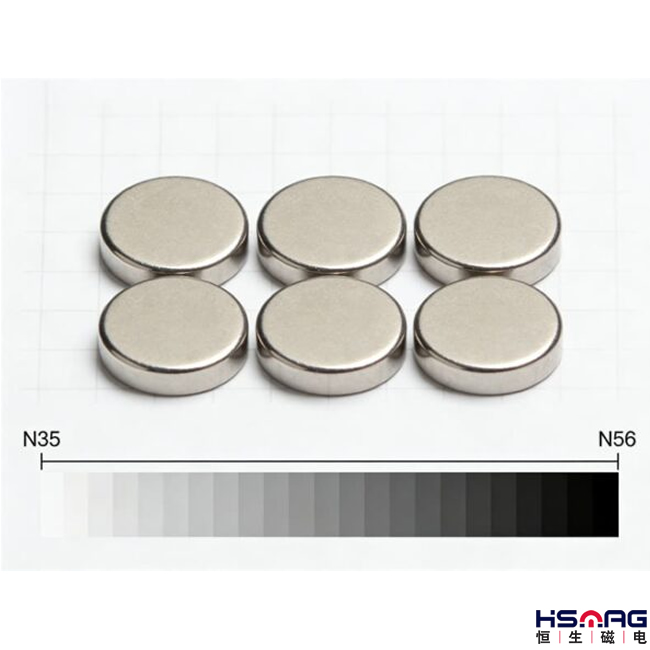
Rare Earth NdFeB Neodymium Disc Magnets
Product Neodymium Disc Magnet (NdFeB / Rare Earth)
Shape Disc (Diameter > Thickness)
Size Identification Diameter × Thickness (e.g., D9 × 3 mm)
Available Grades N35–N56 (high-temperature options available on request)
Magnetization Direction Axial (common), Diametric/Radial (common); other directions available on request
Coating Options Nickel, Zinc, Teflon, Gold, Chrome, Plastic, Epoxy, Parylene
Surface / Features Smooth surface; high magnetic strength; compact size; large magnetic working area
MOQ 1 piece
Lead Time 7 days for regular shapes (fastest); 20 days for custom designs
Ordering Paths Small Order (Sample/Pack) or Bulk Quote (same product, two ordering paths)
Typical Applications Electric motors, speakers, sensors; consumer and industrial products; scientific and medical product design/manufacturing
Custom Capability Custom sizes and thicknesses supported; coating and design options available to fit application requirements
*Pull force values are reference estimates under ideal test conditions (clean, flat steel, direct contact, straight pull). Real holding depends on steel type, surface condition, air gaps, coatings, and alignment.
Pull Force Explained (Why Real Holding Can Be Lower)
Pull force is a useful comparison number—but it’s not a promise in every assembly. The same magnet can behave very differently depending on the magnetic circuit and mounting surface.
What reduces holding in real use:
Air gaps (paint, tape, coatings, uneven surfaces).
Rough or thin steel, small contact area, misalignment.
Side loads/shear loads vs straight pull.
Rust, debris, and repeated impacts.
Practical rule: For critical holds, design with a safety factor and test the magnet in your actual setup.
Magnetization Direction: Axial vs Diametric
Axial magnetization: poles on the flat faces (most common for disc magnets).
Diametric magnetization: poles on the curved sides (useful for rotating fields, sensing, special fixtures).
When to choose diametric:
Sensors, rotating assemblies, or when you need the strongest field across the diameter rather than thickness.
Coating Options (Choose by Corrosion, Wear & Surface Needs)
Osenc offers multiple coatings so your disc magnets match real environments—not just lab conditions.
Coating Matrix
Nickel (NiCuNi) — general indoor use, clean finish.
Zinc — economical corrosion protection for mild environments.
Epoxy — improved corrosion resistance; good for humid exposure.
Plastic — extra barrier protection; helpful for moisture & handling.
Parylene — thin, uniform coating for precision assemblies and sensitive contact.
Teflon — low friction / anti-stick surfaces for sliding contact.
Gold — decorative finish; also used where appearance matters.
Chrome — hard, wear-resistant surface appearance.
Up next: sizes & tolerances—because fit matters as much as force in many builds.”
Sizes & Tolerances (Standard vs Tight Options)
Disc magnets are typically specified by diameter × thickness. Standard tolerance works for most holding and closure uses. For alignment, sensing, or assemblies with press fits, tighter tolerances reduce rework and improve consistency.
What to send for accurate quoting:
Size (D×T) and unit (mm or inch)
Grade (N35–N56)
Coating requirement
Tolerance requirement (Std / Tight)
Quantity (sample / pilot / mass production)
Operating Temperature (Confirm Before Final Grade)
Most standard NdFeB disc magnets are suited for typical ambient conditions. If your assembly sees elevated heat, confirm operating temperature early—temperature affects magnetic performance and long-term stability.
Tip: Tell us your max operating temperature and duty cycle, and we’ll recommend a suitable material option.
Now let’s make selection easier with real-world use cases by industry.
Common Applications for Neodymium Disc Magnets
Sensors & Reed Switches (position sensing, proximity triggers, robotics).
Motors & Generators (compact magnetic circuits, prototypes).
Audio & Electronics (speakers, headphones, fixtures).
Closures & Latches (packaging, furniture, enclosures).
Jigs, Fixtures & Workholding (alignment, temporary holding).
DIY & Crafts (fasteners, mounts, displays).
With adhesive
The adhesive magnet has double-sided tape on its back. You can stick those magnets to a variety of surfaces. And there can be different types of double-sided tapes, which are designed for various applications.
Next: why Osenc—quality checks, traceability, and how we reduce procurement risk.
High Grade Disc Custom Neodymium Magnets
N48 Disc Magnet Neodymium-Iron-Boron
90 °Countersunk NdFeB Disc Magnet
NdFeB Disc Permanent Magnet with Countersunk Hole
Sintered Neodymium Disc Countersunk Magnet
Small Countersunk Disc NdFeB Magnet